
Color Tuning in Classrooms
A study of the effects of providing color tunable and dimmable features to an elementary classroom
Chad Palmer, CLEP, LS-C
Circadian rhythms and human centric lighting, they can mean different things and they are lighting buzz words of today. Our efforts were to explore a practical side of tunable white lighting in an elementary classroom and answer the question, “How would elementary school teachers use color tunable white LED fixtures if they weren’t given any instruction”?
How would dimming and color tuning control be used in an elementary classroom? The conditions were set up to allow the staff to “discover” the new features of the system and decide, on their own, how to use them. The study took place during the 2017 school year and the data was collected in 2018. It was done in 84 classrooms at 3 separate elementary buildings in a Midwest school district.
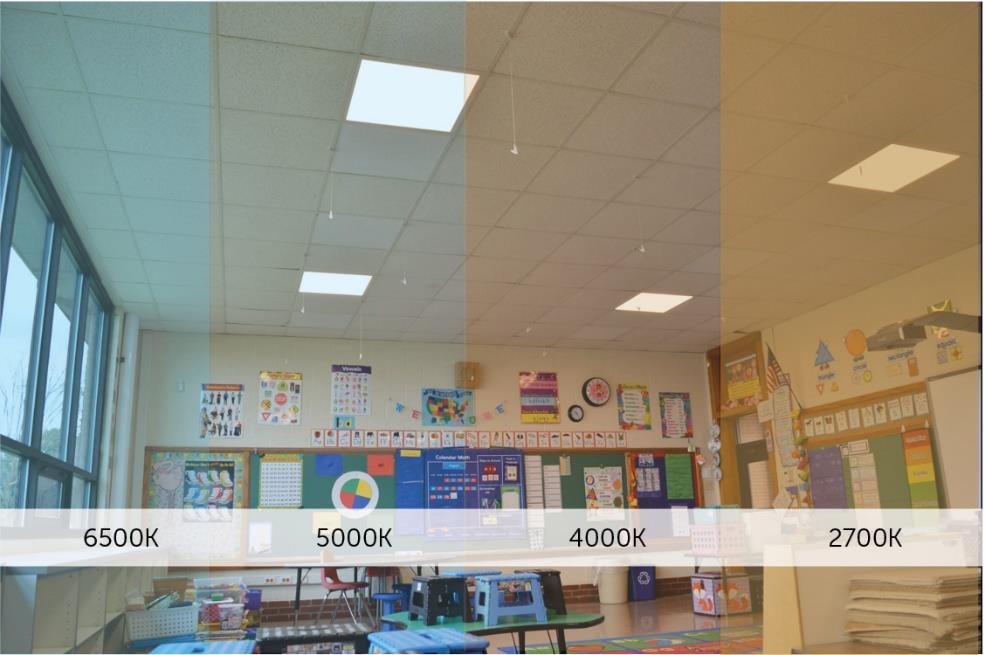
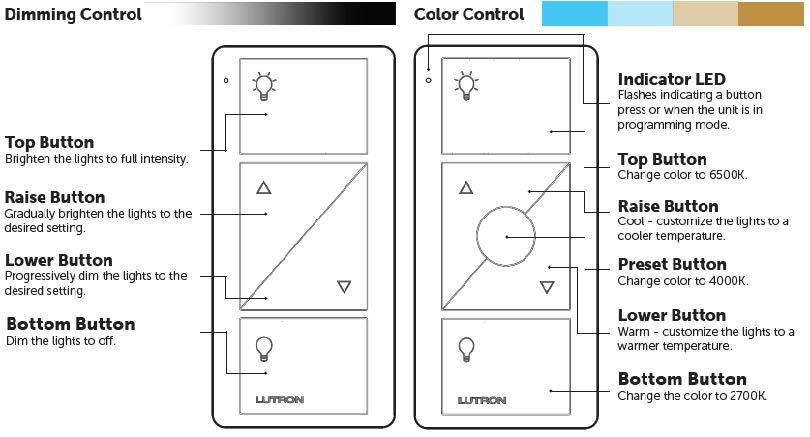
The scope of work included fitting each of the classrooms with new LED, flat panel light fixtures that were 100-10% dimmable and 2700K to 6500K CCT adjustable. We targeted 45 foot-candles for the standard light level on the 4000K CCT setting. The controls consisted of two Lutron Pico 0-10V dimmers. One had only dimming up and down with no preset; the other was the CCT control with 3 presets and up and down.
The data was collected using an online survey. Respondents had to answer all questions in order to complete the survey. We had a 96% response rate. 71 teachers and 8 administration staff responded to our survey out of a total of 74 teachers and 10 administration staff. We polled only those teachers and staff that used the classrooms with the new lighting.
The survey was conducted during the month of May. The school year is typically 185 days starting on or about August 14th and ends on or about May 24th. The instructional part of the school day starts at 8:30AM and ends at 3:00PM; however, the staff spends time in the classroom before and after those hours.
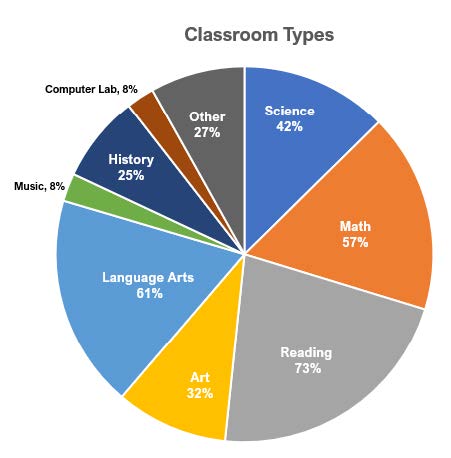
Our survey involved classrooms that were used for teaching kindergarten through 4th grade. The subjects covered are shown in the chart below:
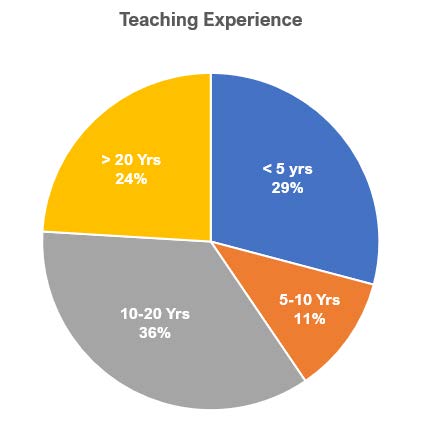
the staff’s experience varied with 36% having 10 to 20 years of experience, as shown here:
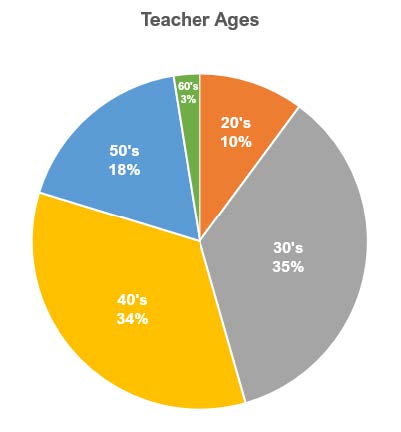
The gender of the staff is mostly female with 75 female teachers and 4 men. Their age was mostly 30-40 years old as shown below:
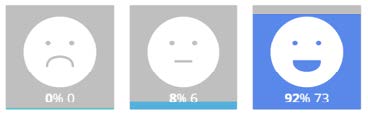
We asked how they felt about the new features of the lighting. Specifically, we asked about the ability to change color: 82% of the respondents said they were happy with the ability to change the color of lighting in their classroom, 16% were indifferent about it and 1 person was not happy.
We also asked the respondents how they felt about the ability to dim their lighting, and 92% responded that they were happy with the ability to dim the lights with only 8% indifferent to it.

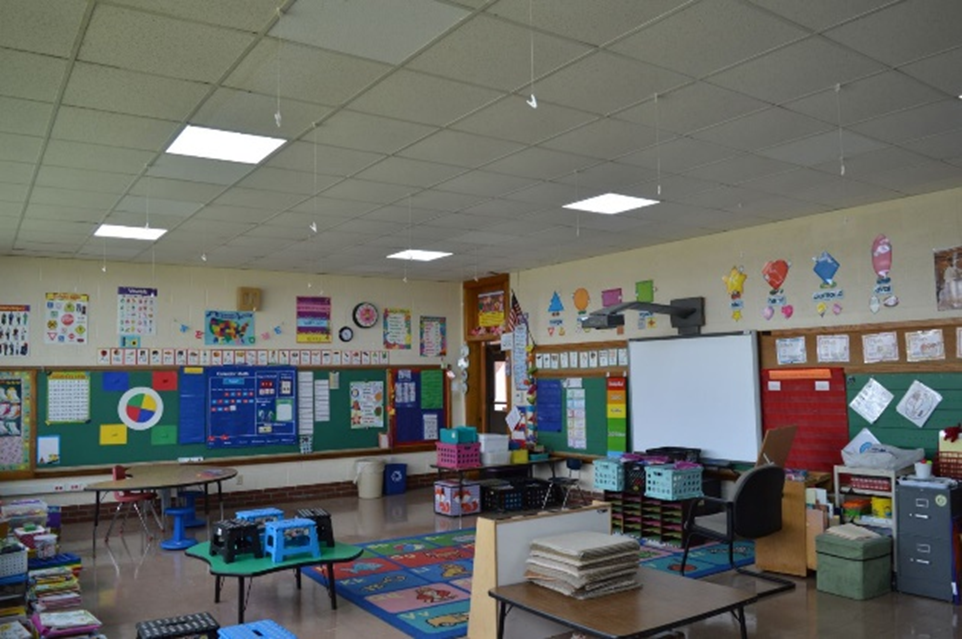
The classrooms were fitted with flat panel type fixtures. We were attracted to the clean modern look, slim profile, enclosed and low-glare optics, dimmability, adjustable color range of 6500K to 2700K, with both 2’x 2’ and 2’ x 4’ shape forms, and its high efficiency. The flat panel is a very versatile fixture for a classroom setting.

The teachers appreciated our choice in fixture style with over 90% of them responding to our survey as satisfied or very satisfied.
Making a difference in the classroom was our ultimate goal. We wanted the teachers to have a next-generation classroom with another tool they could use to improve the education experience and we wanted to give the district a classroom that would be ready for a new curriculum and attract the next generation of teachers. Over 95% of our respondents said the color tuning feature made a positive impact on their classrooms and students. And nearly the same amount said the feature made their classrooms more comfortable for them personally.
These were the first classrooms in the district to have 100 to 10% dimming. Originally, they were fitted with just on/off linear fluorescent fixtures. The teachers responded to the dimming feature similarly to the color tuning feature, with nearly 100% of them telling us the dimming feature made a positive impact on their classroom and students, and with the same amount responding that it made them more comfortable personally.
The teachers were also asked how likely they would recommend color tuning and dimming to their peers. Only 3 teachers responded with not at all likely;
the majority of our teachers were going to recommend both features to their peers.
When the teachers asked if they were trained in how to use the new color changing feature of their lighting, 21% of them said yes, even though they were never formally trained or given formal direction.
Interestingly, there was a small percentage of respondents that were not aware the color of the lighting could be changed in their classrooms and the same said their students were also not aware.
82% Liked Color Changing Feature
92% Liked Dimming Feature
94% of the respondents said they had changed the color of lighting in their classrooms.
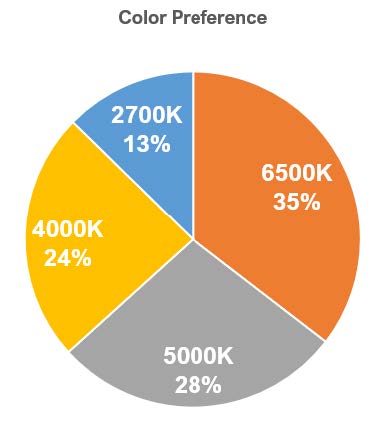
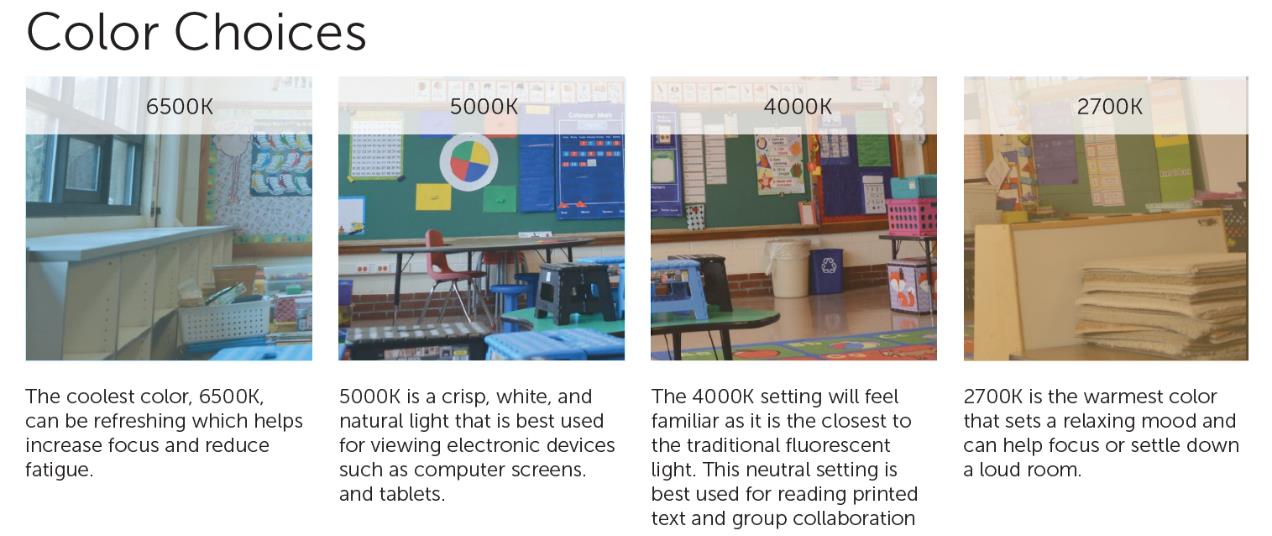
We wanted to know which color they preferred. Teachers prefer bright white color in their classrooms because most of the respondents chose 5000K or 6500K as their favorite CCT. Considering they had to manually adjust the lights to get to the 6500K, it’s fascinating that 35% of the respondents preferred that color.
Over half of our teachers changed the color of their classroom more than twice during a typical day with
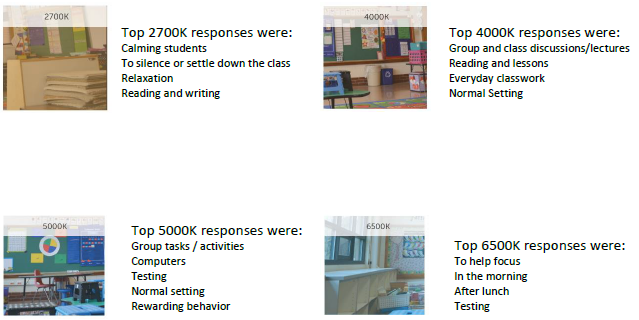
the other half responding that they changed the color only once per day. We were curious to find out what colors the teachers used and especially how and when they used them. 51% of our respondents said they change color to coordinate with an activity. The responses as to how and what they used the colors for is shown below:
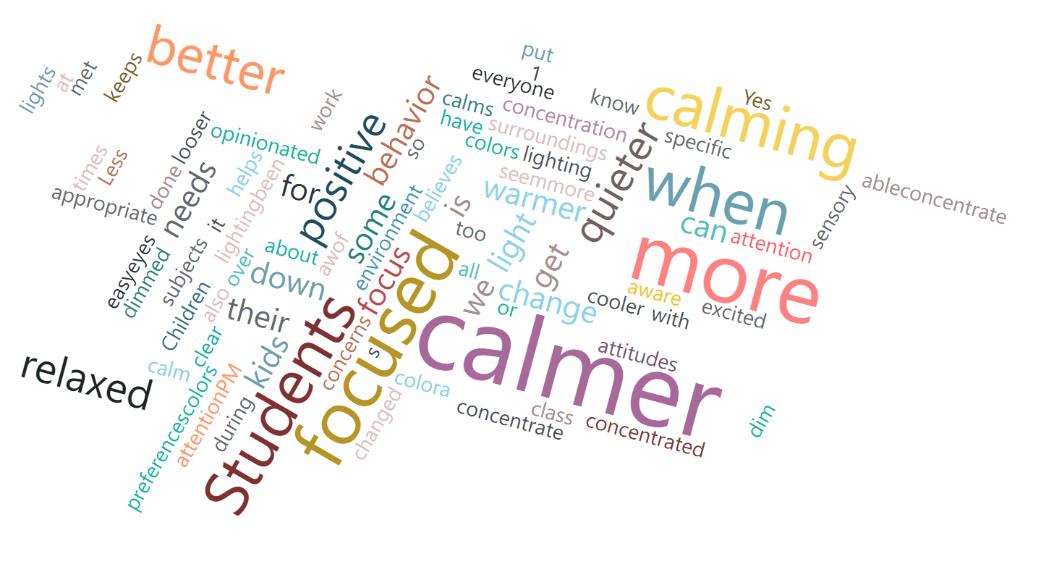
It was speculated that there would be changes in behavior. 37% of our respondents said they noticed changes in behavior that they think are associated with the new lighting. This word cloud shows the words they used to describe the changes in behavior they noticed. 41% of respondents felt changing the color of the lighting helped students concentrate.
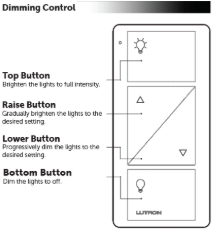
What’s the potential energy savings from dimming? To find out, we asked our teachers where they kept the dimming control set at for their “normal setting”. 89% responded with their normal setting dimmed by 10%, with a notable 20% dimming by 70%. According to our survey, 90% of most users will dim their lights by at least 10%, and 40% of users will dim their lights by 50% or more as their normal setting.
76% of our respondents said they dim the lights for special activities and certain subjects. Some activities are more suited to dimming than others and our teachers responded with the following activities: they use the dimming feature for smart board and projector use, classroom management/quiet time and watching movies/videos. We also received several “other” comments. Most notable were comments saying they dimmed the lights to their own personal light level.
Some teachers did not dim the lights. Why don’t they dim? The responses were because they “forget” about it and just aren’t used to having dimming available.
In conclusion, this school district set out to provide their teachers with new tools in their classrooms to give them a more comfortable classroom and a classroom that would enhance the classroom experience. We accomplished that and added additional energy savings to the project.
Chad Palmer, with over 30 years in the lighting industry is the President, CEO of Energyficient Systems, Inc. a design build turn-key, lighting efficiency contractor that works nationally. For more information contact Energyficient at 800-713-3732 or www.energyficient.com
 407 N. 4th Steet, Suite B